Rare gilded bronze sculpture highlights the artistic legacy of Augustus Saint-Gaudens, the contributions of model Hettie Anderson, and the origins of America’s celebrated Double Eagle gold coin.
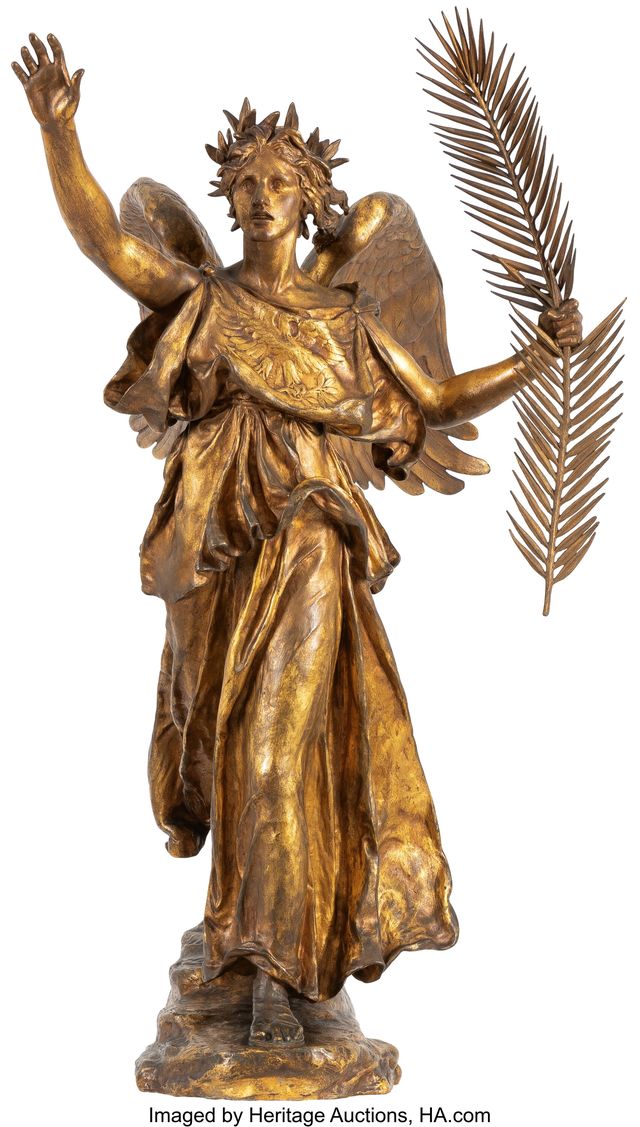
A remarkable chapter in American art and numismatic history will take center stage November 13 when Heritage Auctions offers a rare gilded bronze reduction of Victory by renowned sculptor Augustus Saint-Gaudens. The sculpture will headline the auction house’s American Art Signature Auction, a select offering of 80 lots.
The story behind Victory connects Gilded Age New York, President Theodore Roosevelt’s vision for American coinage, and Hettie Anderson, the Black model whose poise and physical discipline helped Saint-Gaudens bring his artistic vision to life.
From Monumental Sculpture to American Gold Coinage
Saint-Gaudens began work on the Sherman monument in 1892. Unveiled in 1903 at Grand Army Plaza in New York City, the monument depicts General William Tecumseh Sherman on horseback, led by the winged figure of Victory. With outstretched arm, flowing drapery and rising wings, Victory strides forward as an embodiment of triumph and the promise of peace.
Anderson posed for Saint-Gaudens in 1897. Born in Columbia, South Carolina, she had moved to New York by the mid-1890s and became a respected model for prominent artists, including Saint-Gaudens and Daniel Chester French. Her ability to maintain demanding poses was essential to the creation of Victory.
Anderson also took an active role in protecting her own image. After Saint-Gaudens presented her with the first study for Victory’s head, she registered a copyright in 1908 and declined her family’s request to reproduce the portrait bust.
Victory’s influence extended well beyond monumental sculpture. President Theodore Roosevelt admired the Sherman monument and enlisted Saint-Gaudens to help redesign American coinage. Both men believed ancient Greek coins demonstrated that circulating money could also be a work of art.
Saint-Gaudens drew on Victory’s movement and flowing drapery when developing the Liberty design for the 1907 twenty-dollar gold piece, popularly known as the Saint-Gaudens Double Eagle. Holding a torch and olive branch, Liberty brought the grandeur of monumental sculpture to a coin intended for everyday circulation.
A Lasting Numismatic Legacy
The Double Eagle design challenged the U.S. Mint’s production capabilities. Experimental Ultra High Relief and subsequent High Relief versions required multiple strikes, leading to a lower-relief adaptation suitable for mass production.
Saint-Gaudens’s Liberty appeared on Double Eagles through 1933. The design later inspired the American Gold Eagle bullion coin series, introduced in 1986. In 2009, the U.S. Mint revisited the sculptor’s original vision by producing an Ultra High Relief Double Eagle using modern technology.
The gilded bronze Victory offered by Heritage was cast between 1912 and the early 1920s, after Saint-Gaudens’s death in 1907. His widow, Augusta, arranged for a reduced plaster model that could be used to produce the smaller versions. Other examples of the reduction found their way into the collections of The Metropolitan Museum of Art, the Carnegie Museum of Art and the Toledo Museum of Art.
Offered from a Connecticut estate, this example provides collectors an opportunity to appreciate Victory as an independent work of art and to explore the sculptural origins of one of America’s most celebrated gold coin designs.
“Victory brings together so much of what makes American art extraordinary: sculptural beauty, public ambition and a remarkable national story,” said Aviva Lehmann, Heritage’s Deputy Chairman of Fine Art.
For numismatists, the sculpture offers a compelling reminder that the coins we collect are not simply objects of precious metal. They also reflect the artists, historical figures and cultural ideals that shaped American money.
Auction details: Heritage Auctions’ American Art Signature Auction takes place November 13.
View images and information about the auction lots at Heritage Auctions.